Building a Future Worth Inheriting: Umsizi on the Green Economy, Sustainable Development, and the Power of Community
What does it mean to build an economy that works for communities, ecosystems, and generations yet to come? These are the questions that sit at the heart of everything Umsizi does. In a series of recent radio conversations, John-Mark Kilian, CEO of Umsizi, spoke candidly about the green economy, enterprise development, sustainable agriculture, and the hard but invaluable lessons learned over two decades of working at the intersection of corporate responsibility and community development. What follows is a synthesis of those conversations.
The Green Economy: More Than a Buzzword
Few terms in contemporary business discourse are as frequently used, and as frequently misunderstood, as ‘the green economy.’ For Umsizi, the definition is both practical and ambitious: it is an economic model that decouples growth from environmental destruction, one that treats the relationship between commerce and nature not as a zero-sum contest, but as something that can, and must, be made symbiotic.
At community level, the green economy is not abstract. It shows up in sustainable food production, water conservation, regenerative farming, local enterprise development, climate adaptation, and the responsible use of natural resources. When a household learns to grow food using climate-smart agricultural practices, that household is already participating in the green economy, thus improving food security, strengthening resilience, and contributing to environmental sustainability at the same time.
“The green economy is about inclusive growth — ensuring that ordinary communities are able to participate meaningfully in sustainable economic opportunities rather than being excluded from them.”
The green economy also demands a clear-eyed reckoning with history. South Africa’s extractive industries — mining foremost among them — have for generations operated in ways that degraded natural systems beyond their capacity to recover, and often to the detriment of local communities. Reversing that trajectory requires a drastic and immediate change in how industry interacts with nature: preventing further losses, protecting current ecological systems, and restoring what has been damaged. And the reason for this is to conserve the environment for people and future generations, and to grow the local economy in a socially equitable and inclusive manner. This responsibility belongs to government, industry, and civil society alike.
Why Sustainability Is No Longer Optional
There was a time when companies could treat environmental and social governance as a public relations exercise, a compliance box to be ticked, a report to be filed. That time has passed. Today, sustainability is a commercial reality. Investors, regulators, communities, and employees increasingly expect organisations to demonstrate transparency, responsibility, and meaningful social impact. Businesses are evaluated not only on profitability, but on their bottom-line impact and how they manage their environmental, social, and governance responsibilities.
Climate change has made this more urgent still. Extreme climatic changes and disruptive weather events have disrupted supply chains. Resource scarcity, climate change, population growth, and even war, is reshaping entire industries. Organisations that once treated resilience as optional are discovering that it is, in fact, the foundation of long-term sustainability. A robust sustainability strategy — one that unlocks sustainable capital and builds genuine stakeholder trust — is no longer about saving the planet. It is about future-proofing the business.
“Sustainability is no longer simply a moral conversation. It is increasingly becoming a strategic, economic, and operational necessity.”
From Compliance to Shared Value: Umsizi’s Approach to Sustainability and ESG
For twenty years, Umsizi has guided its clients to design and implement sustainable socio-economic solutions. Work that assists organisations in meeting their compliance commitments, but in ways that generate long-term, measurable, and genuinely sustainable outcomes. The team’s conviction is that impact and compliance are not separate things. Meaningful sustainable development or ESG implementation should create real and lasting value within communities, environmental stewardship, and not merely satisfy a regulatory requirement.
This means shifting the corporate mindset from reactive legal compliance to strategic, shared value. Umsizi works with organisations to design structured socio-economic programmes that convert a company’s sustainability spend into self-sustaining local economies. Building thriving micro-enterprises, ensuring local food security, linking small farmers with formal economies, and securing the social licence to operate that underpins long-term business stability.
Within the mining sector in particular, this requires moving beyond short-term community development interventions to long-term programmes of scale and impact — the kind of commitments set out in a Social and Labour Plan. The communities that surround a mine will outlast the mine itself. The most sustainable operation, therefore, is one surrounded by a thriving, self-sufficient community, and not one that has been dependent on the mine which is left vulnerable when the ore runs out.
Agriculture as a Gateway to Economic Empowerment
One of Umsizi’s most tangible expressions of this philosophy is its agricultural and livelihoods development programmes. The team has designed a scalable approach to poverty alleviation, skills development, income generation, and economic growth, centred on sustainable agriculture, offering comprehensive training and livelihoods support accessible to community members regardless of age, education level, gender, or ability. Participants are mentored from the very first session to apply what they have learned, establishing home-based gardens before, for those who choose it, expanding into larger production using organic, regenerative farming methods.
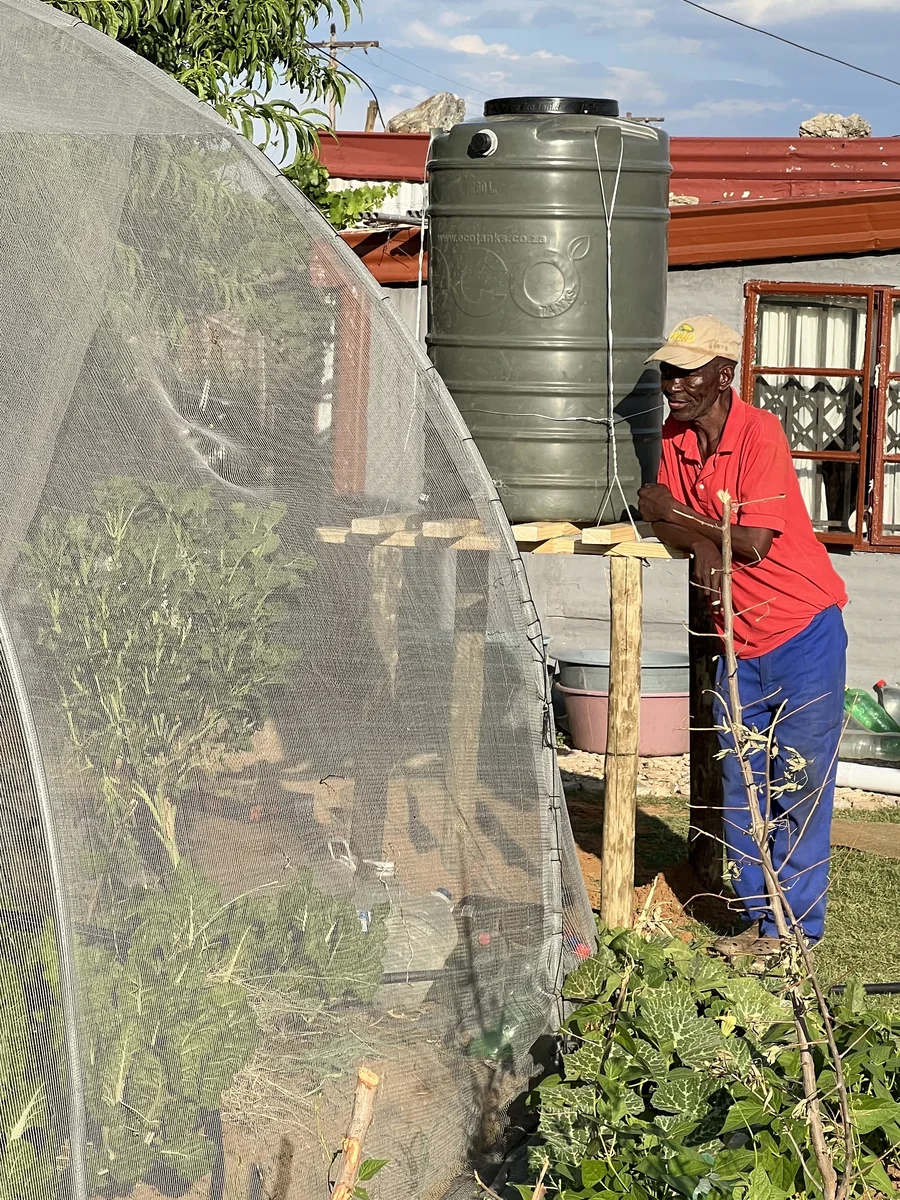

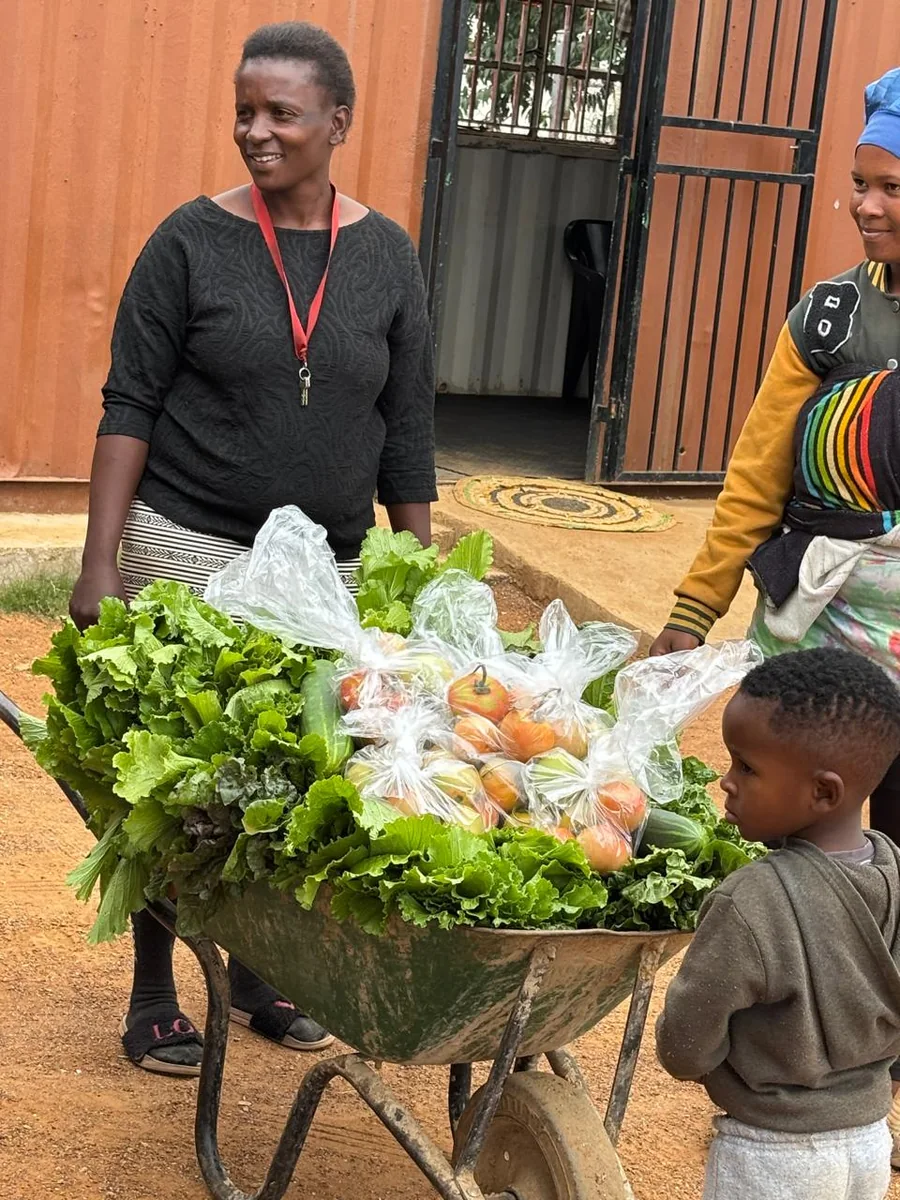
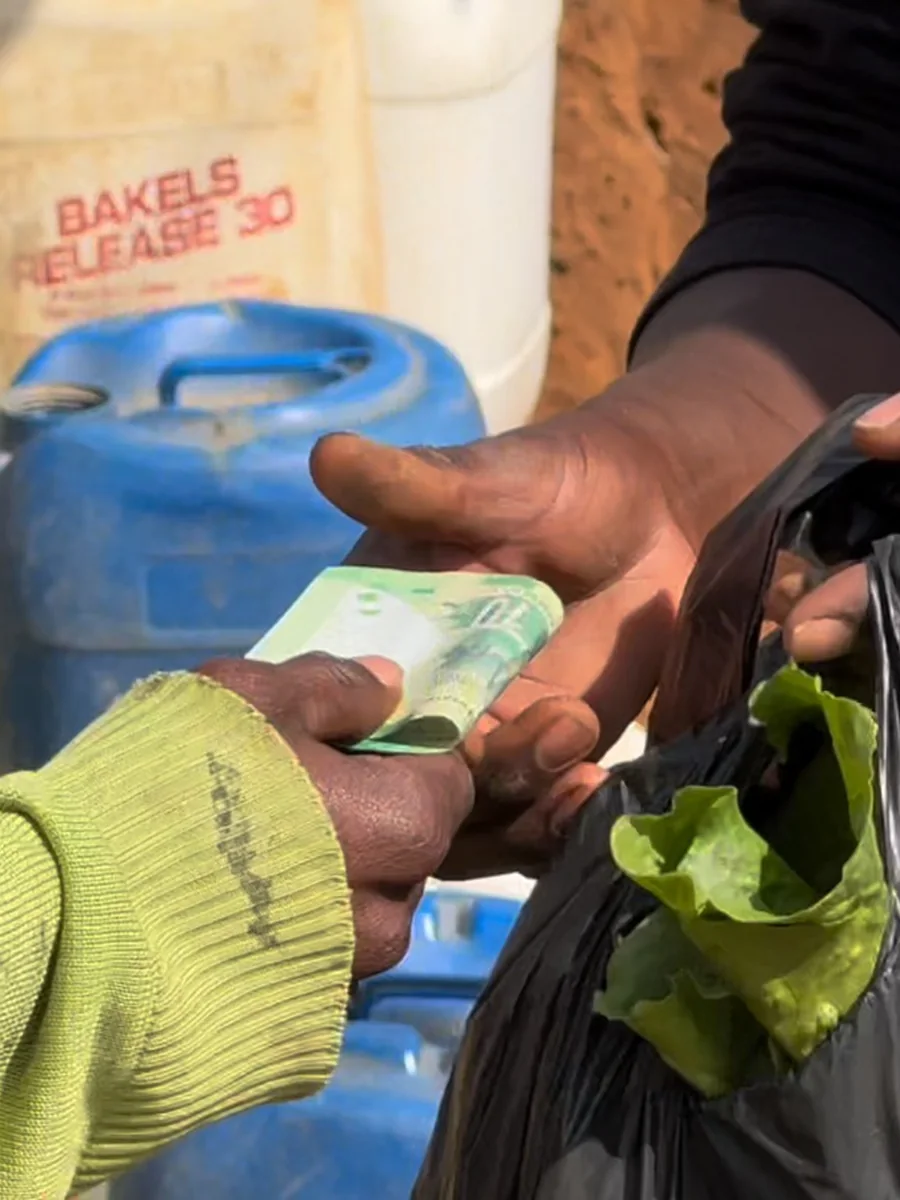
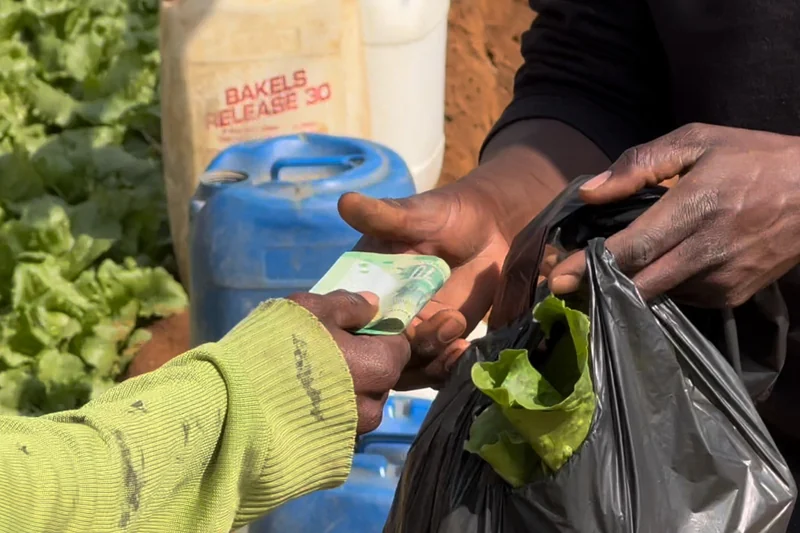
From a home garden to a sale: rainwater harvesting and climate-smart growing, produce packaged for market, and the short supply chain that keeps the margin with the grower.
The technical grounding is substantive: soil regeneration, composting, mulching, water conservation, drip irrigation, grey-water harvesting, and climate-smart production systems. But the ambition extends beyond food security. Communities are encouraged to see agriculture as a pathway toward enterprise development and local economic participation. All communities need food. Local producers who sell directly to the public can capture significantly higher profit margins by eliminating storage, transport, and handling costs from the supply chain.
“What is especially important is that communities themselves become active participants in the process rather than passive recipients of support.”
Enterprise Development and the Local Economy
Enterprise and Supplier Development (ESD) is another foundation of Umsizi’s work. When corporates invest well in ESD, they are pulling localised SMMEs, or assisting local people in starting SMMEs, into the mainstream economy rather than just distributing grants and keeping entrepreneurs dependent. Transforming small start-ups into stable employers can go a long way towards building more resilient and decentralised local economies in communities. Umsizi has set out this approach in more detail in its work on the green economy for sustainable enterprise development.
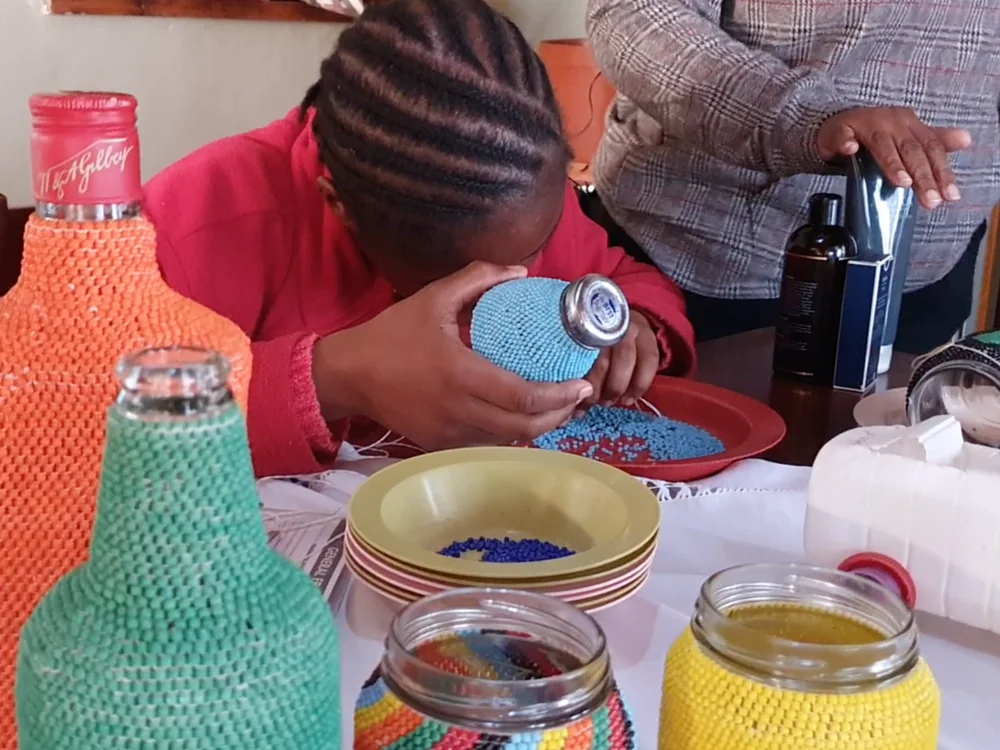

Value added close to home: discarded glass reworked into saleable craft, and garden chillies turned into a bottled product with a price on the label.
The Umsizi approach to Local Economic Development encourages entrepreneurs to start with what they have, where they are, and to get into practical business rather than treating it as a theoretical, abstract skill. This involves empowering entrepreneurs in building their business acumen and confidence, equipping them with powerful business tools, strengthening their capacity, and then undertaking business — whether trading services, produce, food, or goods. Too often, promising businesses never get off the ground while waiting for a ‘cash injection’ that may never arrive. Implementing what has been learned from the very first training session, based on the participant’s capacity — starting small, getting the basics right, then expanding — is a more reliable path to sustainable enterprise than chasing scale before the foundations are secure.
Emerging entrepreneurs in underserved communities face structural disadvantages that have nothing to do with talent or work ethic. Access to reliable electricity, clean water, internet connectivity, market access, and basic services that others take for granted can represent insurmountable barriers. Unlocking the potential of the rural economy requires creative funding mechanisms, accessible development hubs, and investment in the basic infrastructure that allows an enterprise to grow with any degree of security.
Lessons from Two Decades in the Field
After twenty years of working with mining communities and development programmes across South Africa, certain lessons have proven themselves repeatedly.
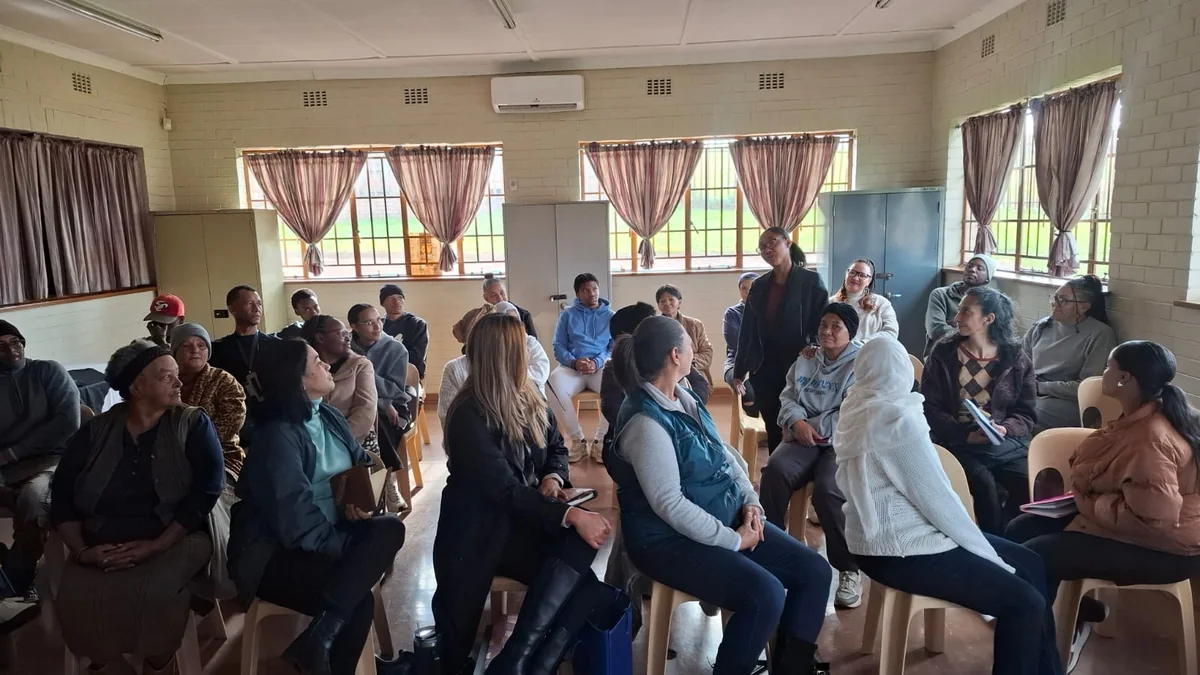
Genuine and inclusive stakeholder participation matters — enormously. Communities want to be heard, respected, and recognised as active stakeholders, not as passive beneficiaries, in participating in and defining their own future. Development programmes become far more meaningful and far more sustainable when communities are involved in shaping the direction of interventions, identifying priorities, and participating in decision-making.
Trust takes time to build, and it has often been broken through empty promises or powerful stakeholders bypassing others. Many communities have lived through cycles of short-term interventions that created expectations, but failed to deliver lasting results. This means that sustainable development approaches must be practical, transparent, ethical, and capable of creating value beyond the immediate project cycle. Real sustainability requires investment in people, skills, local leadership, enterprise development, and long-term community capability, and not just in infrastructure or measurable short-term outputs.
Local context cannot be imported from outside. Solutions that work in one community may not translate to another. Cultural realities, local economic conditions, existing knowledge systems, and community dynamics all shape what is possible and what is sustainable. Equally, no single institution can address complex socio-economic challenges alone. Sustainable development requires meaningful collaboration between communities, corporates, municipalities, traditional leadership, civil society, and development practitioners, built around shared vision and shared accountability.
“Sustainable development interventions must be designed in ways that allow communities to continue growing and sustaining progress long after the formal project cycle has ended.”
What a Successful Sustainable Community Looks Like
For Umsizi, a successful sustainable community is not measured only by economic indicators. It is a community that is caring, sharing, resilient, and deeply connected to the wellbeing of both people and the environment. It is a place where young people can see opportunity locally, where families experience socio-economic security and dignity, where local enterprises are able to grow, and where communities actively participate in shaping their own development journey.
Critically, it is also a community that understands its responsibility as an environmental steward. Long-term economic wellbeing cannot be separated from the health of the natural systems that sustain life itself. Sustainable communities recognise that protecting soil, water, biodiversity, and local ecosystems is not a constraint on development, but rather central to it. The environment is not merely a backdrop; it is the foundation on which everything else is built.
Ultimately, sustainability is about balance: communities that are thriving economically, caring socially, and acting responsibly as environmental stewards. Communities that create hope, dignity, and opportunity today while still protecting the ability of future generations to thrive.
A Vision for the Next Five Years
South Africa has enormous potential within the sectors of the green economy: sustainable agriculture, renewable energy, circular economies, environmental services, and green enterprise development. Unlocking all that potential will require stronger collaboration between government, corporates, entrepreneurs, communities, and development institutions, and a determined shift away from development models that create dependency towards a new era of co-creating with communities a shared and more resilient future for all.
The green economy presents significant opportunities for SMMEs and entrepreneurs willing to position themselves within sustainability-oriented sectors. Businesses that can demonstrate environmentally responsible practices will become increasingly competitive as markets, corporates, and consumers place greater emphasis on responsible sourcing and sustainable supply chains. The businesses that will dominate the next decade are those using innovation and data intelligence to solve the world’s environmental and social problems — turning sustainability into a competitive advantage, not treating it as a cost.
For young people and emerging entrepreneurs, the message is clear: the solution is closer than you think. Start where you are, with what you have, right now. Build gradually, learn continuously, and remain adaptable. Profitability and social impact do not have to compete. The businesses of the future will be those that create economic value while acting responsibly toward people, communities, and the environment.
“For me, the ultimate goal is to see communities becoming more economically active, more environmentally conscious, and more resilient — communities where people are thriving with dignity while acting as responsible environmental stewards for future generations.”
These are not abstract ideals. They are the outcomes that Umsizi works toward, every day, in communities across South Africa.
Umsizi Sustainable Social Solutions (Pty) Ltd is a South African consultancy specialising in socio-economic development, Social and Labour Plan compliance, Local Economic Development, ESG reporting, and stakeholder engagement. Get in touch to discuss your programme.